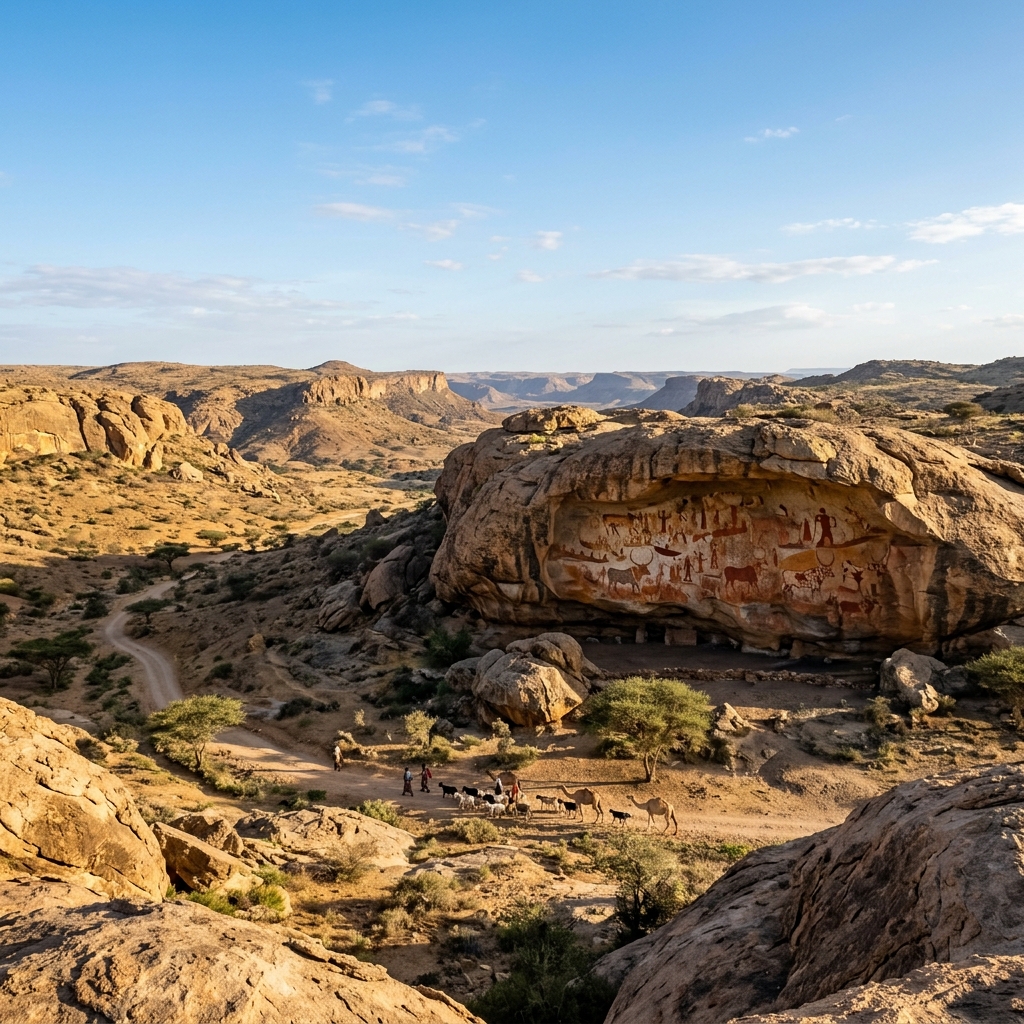
Tucked away inside a cluster of granite alcoves in the semi-desert plains of Somaliland lies Laas Geel, a jaw-dropping collection of prehistoric rock art that is easily one of the most significant archaeological wonders on the African continent. Discovered relatively recently in November 2002 by a team of French archaeologists, these cave paintings have rewrite our understanding of early human pastoralism and artistic expression in the Horn of Africa.
Dating back between 5,000 and 10,000 years, the paintings are spectacularly well-preserved. This preservation is largely due to the dry desert climate and the natural shelter provided by the overhanging granite rocks. When you stand beneath these shelters, the sheer vibrancy of the red, yellow, black, and white pigments is nothing short of breathtaking—they look as if they were painted just yesterday, rather than millennia ago.
The paintings depict a nomadic way of life that centers heavily around cattle. Curiously, the cows are decorated in ceremonial robes and collars, and their necks are often stylized with beautiful curved outlines. Human figures, domestic dogs, and wild antelopes also dot the rock faces. Local legends tell that the caves were once home to spirits, which kept locals away for centuries, unknowingly protecting this global heritage site from vandalism.
Getting to Laas Geel requires a 4x4 vehicle and a certified local guide, both of which are arranged by Sahan Tourism. It is a roughly 1.5-hour drive from Somaliland's capital city, Hargeisa. As you ascend the rugged paths leading to the cave shelters, the sweeping views of the surrounding dry scrubland frame the site in a timeless aura that will make you feel like a true explorer.